What are Buddhist Prayer Beads? Exploring the Spiritual Tool of Traditional Mala
Buddhist prayer beads, commonly called mala, are strings of beads traditionally used as an aid for meditation, mantra recitation, prayer and other Buddhist practices.
A traditional mala is usually made from a series of beads strung together, often with a larger guru or meru bead marking the beginning and end of a complete cycle. Many Buddhist malas contain 108 counting beads, although the number, materials and design can vary between Buddhist traditions.
Mala are not a requirement of Buddhism, and there is no single way that all Buddhists use them. Their use differs between Buddhist traditions, countries and individual practitioners.
In this guide, we look at the history of Buddhist prayer beads, why 108 beads are so common, how malas are used, what the different parts mean, the materials traditionally used to make them, and the role of blessed malas in Buddhist traditions.
Quick Reference - Table of Contents
ToggleHistory of Buddhist Prayer Beads
The history of Buddhist mala is connected with the development of Buddhist practice across Asia, but the precise origins of counting beads are difficult to establish.
Prayer and counting beads have a long history in South and Central Asia, and Buddhist traditions developed their own forms of mala as Buddhism spread beyond India.
As Buddhism travelled through regions including Tibet, China, Korea, Japan and Southeast Asia, different Buddhist communities developed their own traditions concerning prayer beads, including differences in bead numbers, materials, construction and use.
What Is a Buddhist Mala?
The word “mala” comes from Sanskrit and means “garland.” A mala is a string of beads used as a practical aid during meditation, prayer and mantra recitation.
The beads provide a physical method of counting repetitions. Rather than trying to remember how many times a mantra has been recited, the practitioner moves through the beads one at a time.
The term “mala” is used across several Indian and Asian religious traditions. Buddhist malas have developed within different Buddhist schools and regions, so their appearance and use are not completely uniform.
This is important when discussing Buddhist prayer beads: there is no single design or method that represents every Buddhist tradition.
A Traditional Buddhist Account of the 108-Bead Mala
One of the best-known traditional Buddhist stories concerning prayer beads appears in the Muktāvalī, a Buddhist text traditionally associated with the King Vaidunya and the Buddha.
In the story, King Vaidunya asks the Buddha for a simple method of practice that can help people during a difficult period. The Buddha instructs him to make a string of 108 Bodhi seeds and use the beads while reciting the Three Jewels.
The story is important because it provides an early traditional Buddhist explanation for the use of 108 beads.
However, a traditional religious account should not automatically be treated as archaeological proof of the precise historical origin of Buddhist malas.
Did the Buddha Use Prayer Beads?
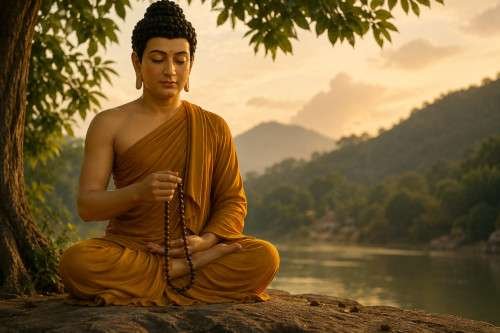
There is no clear evidence that the historical Buddha personally used a mala in the way Buddhist practitioners commonly use prayer beads today.
This does not mean that malas are unrelated to Buddhism. Buddhist traditions developed a wide range of practices involving prayer, chanting, mantra and meditation, and mala became established as a useful counting aid within many of those traditions.
It is therefore more accurate to say that Buddhist prayer beads developed within Buddhist traditions than to claim that the Buddha himself introduced the modern mala.
Different Buddhist schools also have different attitudes toward prayer beads. Some practitioners use them regularly, while others may rarely or never use them.
How Are Buddhist Prayer Beads Used?
The most practical function of a mala is to help count repetitions. A practitioner may repeat a mantra, prayer, Buddha’s name or other sacred phrase while moving from one bead to the next. The tactile movement of the beads provides a physical rhythm and makes it possible to keep count without having to concentrate on the number of repetitions.
For a traditional 108-bead mala, one complete journey around the counting beads represents one cycle. When the practitioner reaches the larger guru bead, the mala is normally turned around rather than continuing over the guru bead.
The exact practice varies according to the Buddhist tradition and the instruction of the practitioner or teacher.
What Is Japa and Mantra Practice?
Japa refers broadly to the repeated recitation of a mantra, prayer or sacred phrase. The term is particularly associated with Indian religious traditions and is used in both Hindu and Buddhist contexts, although practices vary.
In Buddhist traditions, practitioners may use mala while reciting mantras, chanting texts or repeating the name of a Buddha or Bodhisattva. The beads help maintain a count and can also provide a tactile focus during meditation.
A mala therefore does not have to be thought of as a magical object. Its most straightforward function is practical: it helps the practitioner maintain attention and count repetitions.
Why Do Buddhist Mala Have 108 Beads?
The number 108 has a particularly important place in Buddhist and Indian religious traditions. There is, however, no single explanation for why Buddhist malas contain 108 beads that is accepted by every Buddhist tradition. Different traditions have developed different explanations and symbolic associations.
Some Buddhist explanations connect 108 with the number of mental afflictions or defilements that practitioners seek to overcome. Other explanations found within Indian religious traditions connect 108 with sacred texts, cosmology, astronomy, the human body and other symbolic systems.
The traditional explanations should therefore be understood as religious and philosophical interpretations rather than as a single historical explanation for the origin of the 108-bead mala.
The truth is, if there is a single reason why Buddhist Prayer Beads have 108 beads it has been lost to time, with only speculation left as to the meaning of why there are 108 Beads in a Mala Prayer Necklace. The most common explanations for the meaning of 108 beads is
1) Signifying the 108 mortal desires of mankind
2) Allows for 100 Mantas plus 8 mistakes in counting.
3) 27 Constellations x 4 Padas (parts) = 108
4) 12 Zodiac Houses x 9 Planets = 108
5) Upanishads or the Scriptures of the Vedas = 108
Thus, when we recite or recount number 108, we are actually remembering the entire universe. This reminds us of the fact that the universal self is omnipresent, that is the innate nature of the self. This is it’s simple form is the Buddhist Prayer Beads Meaning.
As Buddhism spread and was influenced by various cultures, each Buddhist sect would develop their own traditions associated with the Mala. Some forms of Buddhism and Yoga practitioners also use the Buddhist Prayer Beads as a protective charm and talisman.
The Spiritual Significance of Mantras
Mantras, sacred words or phrases, are an integral part of mala meditation. They hold vibrational energy and aid in focusing the mind, enhancing spiritual awareness, and transcending mundane thoughts.
The use of Buddhist Prayer Beads and Mala as a counting mechanism for the Mantra have made the Buddhist Mala Necklace an important art of religions that focus on meditation
How to Use Buddhist Prayer Beads
Buddhist Prayer Bead Mala are primarily used as a tool to aid Japa Meditation and are used for this purpose by Buddhist and Non Buddhist alike. The Mala is also a form of Buddhist Robe, used as a symbol or spiritual Intention to carry reminders and Blessings of those seeking a Spiritual Path.
a) Count the number of times a mantra or breaths are taken during meditation or
b) Used as magical jewelry to remind of spiritual intention or carry blessings
1) Buddhist Prayer Beads Uses and Meaning - Mala Used Mindfulness Meditation
The most common form of Meditation in both Hindu and Buddhist forms is the called Mantra Meditation or Japa Meditation. Mantras are a slogan or statement used to focus the wandering mind to a central theme or baseline position. Using a Meditation Mantra is called Japa Meditation and each Mantra is repeated hundreds or even thousands of times during a Japa meditation practice. Focusing on the Mantra, allows the person performing meditation to zero in on just one thought and aids in the purpose of stilling the Mind.
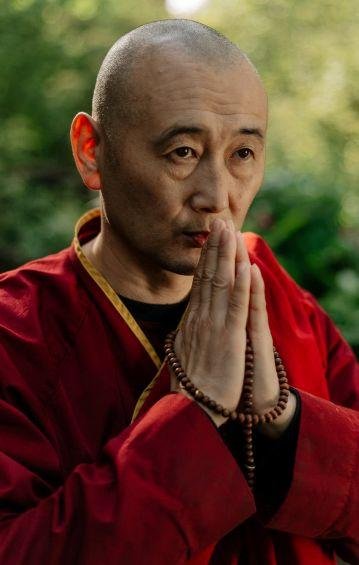
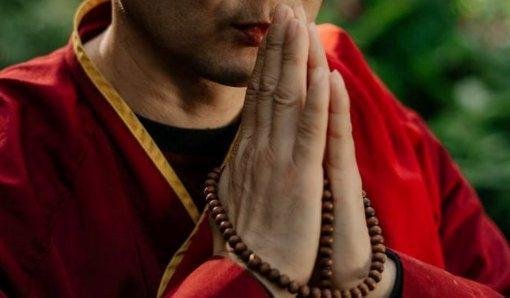
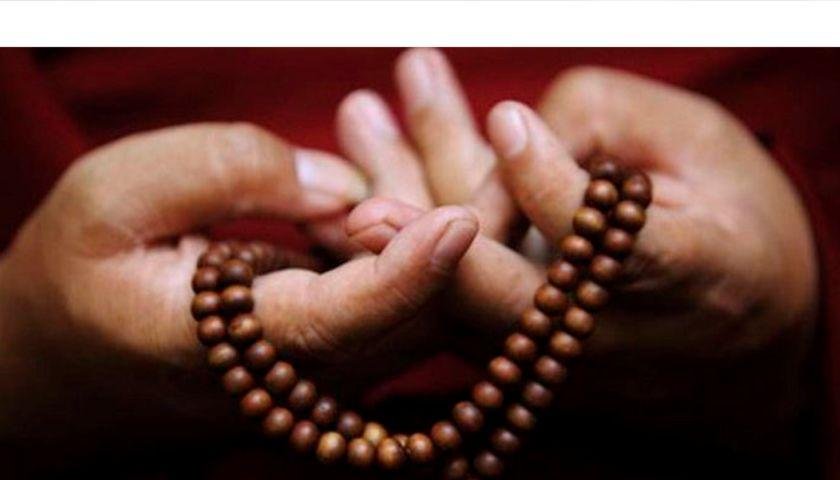
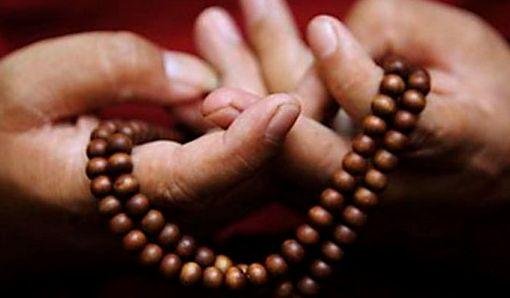
The purpose of meditation is to still the mind, and keeping track of how many mantras you recite during your Japa meditation requires concentration and active conscious thinking. The mala is used so that one can focus on the meaning or sound of the mantra rather than counting its repetitions. One repetition of the mantra is usually said for each bead while turning the thumb around each bead.
This process is repeated and when arriving at the head or guru bead, the person meditating turns the mala around and then goes back in the opposing direction. Typically one cycle of Mantras is about 100, (sometimes 108) but generally what ever philosophy of Japa you are using, by the time you reach 108 counts you start a new cycle.
If more than 108 repetitions are to be done, or the style of mediation requires suggested numbers of mantra repetitions then counting devices can be added to the Mala. What are Buddhist Prayer Beads
The 109th bead on a mala is called the sumeru, bindu, stupa, or guru bead. Counting should always begin with a bead next to the Guru. In the Hindu, Vedic tradition, if more than one mala of repetitions is to be done, one changes directions when reaching the Guru Bead rather than crossing it.
For more: …. Step by Step Instructions on Mala Counting for Meditation
2) Buddhist Prayer Beads Uses and Meaning - Mala Used for Personal Protection
A largely unknown use of Buddhist Prayer beads but one with long traditions is as a sacred and blessed object used as a charm of talisman. Especially popular with local peoples of many Asian cultures including Thailand, the Mala is blessed by a Monk and worn as not only a reminder to live a good life, but as a magical source of luck and protection.
Modern Yoga practitioners have also started to use the Mala as a personal devotion jewelry item that is worn as jewelry. Often referred to and sold as ‘Inspired Jewelry’ incorporating gemstones and objects from a variety of philosophies that each individual Yoga practitioner decides is a right fit for them.
At Monk Mala, we provide authentic Buddhist Mala that have been blessed by Monks and made with simple, native and natural materials found in the local area. These Mala have been Blessed by one of many specialized Monks with a personal protection prayer to be worn as Buddhist Monk Jewelry.
It is the ideal of wearing your Buddhist Prayer beads as a protection amulet that created the use of ‘worry beads’. In times of stress, one can fiddle with the Worry Beads, creating a personal contact and connection to the Protection Blessing it contains
Common Questions regarding Buddhist Prayer Beads
Are Buddhist Prayer Beads Required in Buddhism?
No.
A person does not have to use prayer beads to practice Buddhism. Mala are a practice aid, and their use differs between Buddhist traditions, teachers and individual practitioners. Some people use them every day for mantra or meditation practice. Others may use them only during particular practices, while some Buddhists do not use prayer beads at all.
This is important for anyone new to Buddhism: owning a mala does not make someone Buddhist, and being Buddhist does not require owning a mala.
Can anyone use Buddha prayer beads, regardless of their religious beliefs?
Absolutely! Buddhist prayer beads are not exclusive to any particular religion and can be used by anyone seeking spiritual growth and mindfulness.
Buddhist prayer beads come in handy for meditation purposes. They provide a person with a way to keep track of breathing techniques and mantras as they go along the mala.
In addition to using the mala beads for meditation, they can also be worn as an accessory and a way to embrace their energy on a continual basis. Individuals who want to wear the Buddhist prayer beads can do so by wearing them as a necklace. Monk Mala Buddhist Prayer Beads have been Blessed by Monks so this initial energy will be within the Mala Bead Necklace. Over time your own energies will begin to infuse and reinforce this Monks Blessing.
However you choose to wear your Buddhist prayer beads, you should try to not let them touch the ground as this may ground the energies contained within them. So keep this in mind when taking them off and storing them.
What is the meaning of the Buddhist Mala Guru Bead?
The primarily use of the Prayer Mala Guru Bead is as a measure of counting the cycles of Mantra. It allows the user to know without any conscious effort when a cycle has been completed. The guru bead represents the relationship between the student and the guru or spiritual method being used.
Once you have completed a full circuit of the mala and reached the guru bead again, you reverse direction by flipping your mala. Then you continue again in reverse order. Most people believe that you do not cross over the guru bead as a sign of respect towards one’s spiritual teachers.
Choosing the Right Prayer Bead Mala for You
Incorporating Buddhist prayer beads into your spiritual practice can be a transformative experience. As you explore the world of malas, you open the door to deeper self-awareness, inner peace, and a profound connection to the universe. So why wait? Begin your journey with these sacred beads today!
Today there are many people selling many different types of Buddhist prayer beads. The mala beads come in various styles, colors, and materials. When you choose your Buddhist prayer beads, you should keep the following considerations in mind:
- Real and Authentic Buddhist Mala Beads: Buddhist prayer beads are made by many different people ranging from the Authentic Buddhist Mala Beads found at Monk Mala to fashioned jewellery made by people who work in Yoga studios. Here you need to consider the intention behind wanting a Buddhist Prayer bead … do you want the pure and traditional item or something that was created with intentions influenced by a individual new age philosophy?
- Type of material: Real Buddhist prayer beads are made of just a few different materials. Usually holy woods and seeds, and on rare occasions Gem Stones. The variety of different gemstones sold in today’s market often come from regions not natural to Buddhist countries.
- Color: The color of the mala may be chosen simply for aesthetic purposes while other times you might want to choose a certain color based on what it represent
- Tassel or pendant: Many Buddhist prayer beads have tassels or pendants on them. Real Buddhist Prayer beads tend to just have beads or a tassel on them. Decorations tend to be a western influence.
- Guru bead: The guru bead is also unique in its color and design, so you can choose a mala with a guru bead that best speaks to you
Buddhist Mala Blessed by Monks in Thailand
Monk Mala is based in Chiang Mai, Thailand, and our work with Buddhist Monks gives us a direct connection to the traditional Buddhist environment in which many of our customers want their malas to be used.
Selected malas are taken to Buddhist Monks in Thailand for blessing before they are sent to customers. The blessing is not a replacement for the practical purpose of the mala. A mala can still be used to count mantra or prayer repetitions while also carrying personal and religious significance associated with its blessing.
Blessings Included
Safe Travel
Inner Peace
Good Luck &
Personal Protection
Resource to What are Buddhist Prayer Beads? wikipedia