How to Fix Broken Mala Beads
If your mala beads have broken, you do not necessarily need to replace them. In many cases, the beads themselves are perfectly good and only the cord has worn out or broken. If you have kept the original beads, you can often fix a broken mala by restringing it and rebuilding the original arrangement.
This guide explains how to fix broken mala beads, how to restring a mala, and how to restring broken prayer beads while preserving the original beads, guru bead and tassel.
What Should You Do When Your Mala Breaks?
Quick Reference - Table of Contents
ToggleThe first thing to do when a mala breaks is to collect all the beads and keep them together. Do not throw away the broken cord. It can help you understand how the mala was originally constructed, including the bead order, knotting and connection to the guru bead.
Before doing anything else:
- Collect all the beads.
- Count the beads.
- Keep them in their original order if possible.
- Photograph the mala and its construction.
- Check whether the beads themselves are damaged.
- Examine the cord, knots, guru bead and tassel.
- Decide whether you can repair the mala yourself or whether professional repair would be better.
If the beads are intact and the cord is the main problem, fixing a broken mala may be relatively straightforward.
Can Broken Mala Beads Be Fixed?
Yes. Most broken mala beads can be fixed if the individual beads are still intact. The word “broken” can mean several different things. Sometimes only the string has broken. In other cases, a knot has come loose, a tassel has detached or one or more beads have been damaged.
If only the cord has failed, the original beads can usually be used again. This is one reason it is worth keeping the beads after a mala breaks. The beads may have personal, religious or sentimental significance that cannot simply be replaced by buying another mala.
Why Do Mala Beads Break?
Mala beads are handled repeatedly, particularly when they are used for meditation or mantra practice. Each time the beads are moved through the fingers, the cord experiences a small amount of friction. Wearing a mala around the neck can also cause movement and friction between the beads, cord and clothing.
Over time, the cord may:
- Become thin or frayed
- Stretch
- Develop loose sections
- Break
- Pull away from the guru bead
- Become damaged around the knots
Moisture, dirt, oils from the skin and general daily use can also contribute to wear.
A broken cord does not necessarily mean there is anything wrong with the beads.
How to Tell What Is Broken
Before attempting to repair a mala, identify the damaged part. If the cord is visibly worn, frayed or broken but the beads are intact, restringing is usually the most obvious repair. A mala with individual knots between the beads may develop loose knots over time, and these can sometimes be repaired without replacing every part of the mala, although completely restringing the mala may produce a more secure result.
If one or more beads are missing, you will need to decide whether to find matching replacements or restring the mala using the remaining original beads. A cracked bead may be more difficult to repair, and depending on the material and extent of the damage, replacing the bead may be safer than trying to repair it. If the connection around the guru bead has failed, the mala may need to be partially or completely restrung.
What You Need to Fix a Broken Mala
A simple mala repair may require the original mala beads, strong and suitable cord or beading thread, a beading needle if necessary, small scissors, a clean tray or cloth, the original guru bead and the original tassel if it can be reused.
The correct cord depends on the size of the bead holes and the way the original mala was constructed. A cord that is too thick may not pass through the beads or guru bead, while a cord that is too thin may wear more quickly. If the original mala was individually knotted, choose a cord that allows you to reproduce those knots securely.
Photograph Your Mala Before Repairing It
Before taking your broken mala apart, take several photographs. Photograph the complete mala, the bead arrangement, the guru bead, the tassel, any marker or spacer beads and the areas where the original knots are visible.
This is particularly important if your mala contains different materials, colours or sizes of beads. If the cord has broken but the beads are still together, avoid mixing them unnecessarily. Keeping the original arrangement makes it much easier to rebuild the mala as it was.
Count the Mala Beads
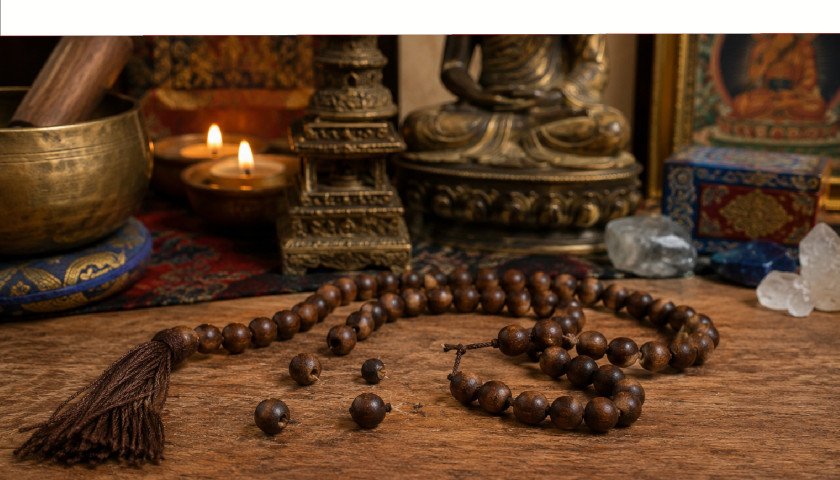
Count all the beads before restringing. A traditional mala commonly has 108 counting beads plus a guru bead, although mala designs with different numbers of beads are also used.
If you are repairing a 108 bead mala, confirming the count helps make sure that no beads have been lost. The guru bead is normally not included in the count of the 108 counting beads. If your mala originally had a different number of beads, preserve its original arrangement rather than changing it simply to make it conform to a 108 bead design.

Does a Broken Mala Have a Spiritual Meaning?
Many people ask whether a broken mala has a spiritual meaning. There are different beliefs about this. Some practitioners interpret a broken mala symbolically, perhaps as the end of a period of practice, a reminder of impermanence or a transition in life. Other practitioners simply regard a broken mala as the result of normal wear and tear. There is no single interpretation that applies to every Buddhist tradition or every Buddhist practitioner.
It is therefore better not to assume that a broken mala automatically represents a particular spiritual event. If the mala is meaningful to you, repairing it can allow you to continue using the same beads in your meditation or Buddhist practice. Buddhist Monks do not panic when their Prayer Mala break, them simple resting the broken Mala when they have time.
Materials Needed to Restring Broken Mala Beads
Before you begin, gather the necessary materials:
- Strong Nylon or Silk Thread: Choose a durable thread that matches the original color.
- Needle: A beading needle to help string the beads.
- Scissors: For cutting the thread.
- Bead Board or Tray: To organize the beads and prevent them from rolling away.
- Glue: Optional, for securing knots.
- New Beads (optional): In case some original beads are lost or damaged.
Step-by-Step Guide to Restringing Broken Mala Beads and Prayer Bead Necklace
Step 1: Collect the Original Beads
Place the beads somewhere clean and secure. Count them and check each bead for damage. Keep any distinctive beads, markers or spacers separate so that they can be returned to their original positions.
Step 2: Preserve the Original Order
Arrange the beads in the order in which they originally appeared. If the beads are all identical, this is simple. If your mala contains different materials, colours or sizes, use your photographs to confirm the arrangement.
Preserving the original order is particularly important for a mala that has personal or religious significance.
Step 3: Choose Suitable Cord
Select a cord that fits through the bead holes and is appropriate for regular use. The cord should be strong enough for the weight of the beads but not so thick that it makes the mala difficult to construct.
If the original mala was individually knotted, choose a cord that allows you to reproduce those knots securely. Matching the general construction of the original mala will usually produce a better repair than simply putting the beads onto a new piece of string.

Step 4: Thread the Beads
Thread the beads onto the new cord in their original order. Work slowly and keep the beads organised. If the original mala was hand-knotted, recreate the knots between the beads as you go rather than threading the entire mala first and attempting to add the knots afterward.
Step 5: Create the Knots
Many traditional malas have knots between individual beads. These knots separate the beads and help control their movement. They also have a practical benefit because if the cord breaks, the beads may not all fall away at once.
The exact knotting method varies between mala styles. The objective is to create secure, consistent knots without making the mala excessively tight. The finished mala should still move naturally through your fingers when used for meditation or mantra practice.
Step 6: Reattach the Guru Bead
Once the counting beads have been restrung, reconnect the guru bead. The guru bead is generally larger than the counting beads and marks the end of a complete round of the mala.
Make sure the connection is secure before continuing. The construction around the guru bead can experience considerable stress during regular use, so this is an important part of the repair.
Step 7: Reattach the Tassel
If the original tassel is still in good condition, it can usually be reused. If it is damaged, it can be replaced with a new tassel. Mala designs vary, so there is no single universal tassel style.
Step 8: Check the Finished Mala
Before using the repaired mala, check the entire strand. Look for loose knots, uneven tension, damaged beads, weak connections, a loose guru bead attachment or a loose tassel attachment.
The mala should feel secure but should still move naturally through your fingers. Avoid testing it by pulling the strand aggressively, as this could place unnecessary stress on the newly repaired cord.
How to Fix Broken Buddhist Prayer Beads FAQ
Should You Put Knots Between Mala Beads?
Not every mala is made with individual knots. Many traditional hand-knotted malas have a knot between each bead, while other malas use different construction methods.
Knots have several practical advantages. They separate the beads, help maintain the shape of the mala and can reduce the number of beads that fall away if the cord breaks. When repairing an existing mala, the best approach is normally to follow its original construction rather than changing it unnecessarily.
What If You Lost Some Mala Beads?
If some beads were lost when your mala broke, you have several choices. You can find matching replacement beads, use the remaining original beads, rebuild the mala using a different arrangement. Remeber the purpose of the Mala is to count at least 100 mantras, so long as you have 100 beads the prayer bead still functions for its purpose.
If the original beads have significant personal or religious meaning, keeping the remaining beads may be more important than making the finished mala look exactly as it did originally.
Does a Broken Mala Mean Bad Luck?
A broken mala does not automatically mean bad luck. Mala cords are physical objects and can eventually wear out through regular use.
Some people attach symbolic meaning to a broken mala, while others see it simply as an indication that the cord needs to be replaced. There is no universal Buddhist rule that a broken mala represents bad luck or that it must be discarded.
Can a Monk-Blessed Mala Be Repaired without a new Blessing?
Yes. If a mala has been blessed by a Buddhist Monk or teacher and the beads remain intact, it can generally be repaired rather than replaced. The original beads can remain on the mala even though the cord is new.
While the blessing initially charges the Buddhist Prayer beads with some functions – your time in reflective mediation has changed and made that blessing more personal and powerful. There is no need to have them reblessed.
Should You Fix or Replace Your Mala?
Repairing a broken mala is often worthwhile when the original beads are still intact, the mala has sentimental value, the mala was blessed, the beads are difficult to replace, the cord is the main damaged component or you want to continue using the same mala.
Replacing the mala may make more sense when many beads are missing, several beads are cracked, the bead holes are damaged, the original construction cannot be safely reproduced or you would prefer a completely new mala.
There is no requirement to discard a mala simply because its cord has broken.
When Should You Have a Mala Professionally Repaired?
Simple mala repairs can usually be completed at home. There are hundred of Youtube videos on the subject to show you how to repair a broken Prayer Bead Necklace
Caring for Your Restrung Mala Beads
Proper care ensures the longevity and spiritual integrity of your mala beads. Here are some tips:
- Regular Inspection: Check for signs of wear and tear regularly.
- Clean Gently: Wipe the beads with a soft cloth. Avoid harsh chemicals or soaking them in water.
- Store Carefully: Keep your mala in a special pouch or box to protect it from damage.
Tips for Mindfulness While Restringing
Restringing your mala beads is not just a practical task but also a meditative process. Here are some tips to stay mindful:
- Set an Intention: Begin by setting a positive intention for the restringing process.
- Stay Present: Focus on each bead and the process of threading it. Use this time as a meditative practice.
- Chant Mantras: Recite your chosen mantras or affirmations as you work, infusing the beads with spiritual energy.
Find your Perfect Buddhist Mala